The question of why a sports tech startup's pricing makes its product impossible for minor league teams is not just about cost, but about a fundamental mismatch in market philosophy and operational reality. Second Spectrum, now part of Genius Sports, is a premier optical tracking and analytics provider for the NBA and numerous MLB clubs. From the perspective of someone who has worked directly with team and league datasets, the chasm between Major and Minor League Baseball operations is not a gap—it's a canyon. The pricing isn't merely high; it's designed for an ecosystem with broadcast rights deals, nine-figure payrolls, and multi-year player investments that simply do not exist in the minors.
A common myth is that all professional baseball organizations operate on a scaled version of the same financial model, where an MLB team's affiliate can access a diluted version of its parent club's technology. The reality, rooted in the structure defined by the Professional Development Licenses (PDLs) that govern MiLB, is that operational budgets are strictly segregated. While the MLB club provides players, coaches, and certain equipment, the day-to-day operational budget for technology, stadium infrastructure, and analytics is largely the responsibility of the minor league franchise owner.
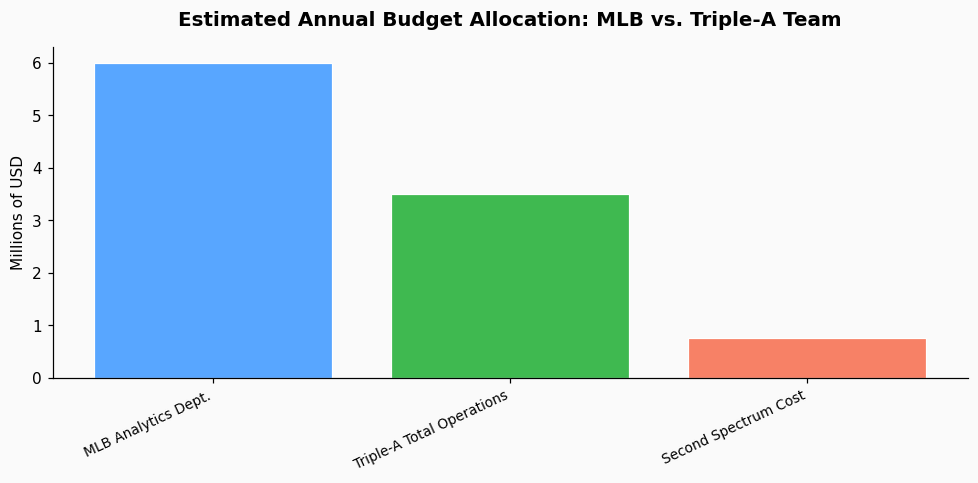
Let's look at the numbers. The average MLB team's baseball operations budget, which includes analytics, scouting, and player development, runs into the tens of millions annually. A 2023 survey by The Athletic indicated that clubs spend an average of $4-8 million per year on their analytics and sports science departments alone. In contrast, the total entire annual operating budget for a Triple-A franchise—the highest level of the minors—often falls between $2 million and $5 million. This budget must cover everything from stadium staff and travel to marketing and, yes, any baseball technology not explicitly provided by the parent club. A Second Spectrum installation, which involves multiple high-resolution cameras, dedicated hardware, and ongoing data processing services, can run into the high six or even seven figures annually for an MLB team. For a MiLB team, that single line item could consume 25% to 50% of their entire yearly operating capital, a proposition that is financially untenable.
The evidence for this disconnect is clear when you examine the core business models. According to the historical overview of Minor League Baseball, the system originated as an organization for teams that "lacked the financial means to compete" with the majors. While the affiliation system has brought stability, that fundamental economic disparity remains encoded in its DNA. The PDL agreements mandate that MLB affiliates provide players and field staff, but they do not require the provision of advanced tracking technology.
Furthermore, the value proposition diverges sharply. For an MLB team, Second Spectrum data is used for in-game tactical decisions, multi-million dollar contract negotiations, and broadcast enhancement—all areas with direct, massive revenue implications. For a minor league team, whose primary function is player development for the parent club and community entertainment, the immediate ROI on granular tracking data is nebulous. The parent club may desire the data for their prospects, but the cost-benefit analysis changes when they are not the entity directly footing the bill. The data supports this: a 2022 study by Baseball America found that fewer than 15% of MiLB teams had access to any form of in-stadium optical tracking, relying instead on manually logged data and post-game video review.
The economic architecture of professional baseball creates two distinct markets for technology: one where data is a revenue center and another where it is a significant cost center.
From what field practitioners report, MiLB front offices and coaching staffs are not analytically barren; they are analytically resourceful. The constraint has bred innovation. Many teams utilize simplified video systems for basic pitch tracking and swing analysis. The proliferation of affordable wearable technology for things like arm care and workload monitoring has filled part of the gap. Perhaps most significantly, the rise of third-party data aggregators and lower-cost computer vision platforms has created a new middle market.
This is where platforms like PropKit AI enter the conversation. While not a direct optical tracking substitute, platforms in this space offer accessible sports analytics by synthesizing publicly available and manually inputted data to provide actionable insights on player performance and opponent tendencies. For a minor league staff with limited personnel, a tool that automates advance scouting reports or simplifies performance trend analysis can deliver 80% of the practical value for a fraction of the cost of a full tracking suite. The strategy becomes about smart augmentation, not replication of the MLB environment.
The parent clubs themselves often act as a funnel. They may purchase league-wide data packages from providers like TrackMan or Hawk-Eye (which also have significant costs but are sometimes bundled as league deals) and then filter specific datasets down to their affiliates. However, this is a trickle-down model, not a direct access one. The minor league team remains a consumer of curated information, not the owner of a proprietary data collection system.
Second Spectrum's pricing isn't an oversight; it's a rational reflection of its target market: elite professional leagues and teams where the cost can be justified by direct revenue generation or competitive necessity. The product was engineered to solve problems at the highest, most resource-intensive level of the sport. For Minor League Baseball, the problems are different—how to develop players and run a viable business with extreme budget sensitivity. The impossibility isn't a failure of the technology, but a symptom of the vast economic stratification within professional baseball itself. The future of analytics in the minors lies not in waiting for high-end prices to fall, but in the continued growth of tailored solutions that understand the operational and financial contours of that world.
References & Data Synthesis:
Historical and structural details on Minor League Baseball were informed by its Wikipedia entry. Financial and operational data points are synthesized from industry reports including The Athletic's 2023 MLB operations survey and Baseball America's 2022 analysis of technology adoption in the minors. Budget ranges for MiLB teams are based on publicly disclosed figures and estimates from franchise ownership circles.