The promise of artificial intelligence to predict and prevent athletic injuries has been one of the most compelling narratives in sports technology over the last decade. Startups like Zone7 emerged with sophisticated models, promising to analyze training load, biometrics, and performance data to flag athletes at risk. While professional franchises, particularly in European soccer and some MLB clubs, have experimented with these tools, adoption at the college level has been conspicuously slow. The failure of platforms like Zone7 to gain significant traction with NCAA programs isn't a story of bad technology, but rather a stark lesson in the economic, operational, and cultural realities that separate the pros from the collegiate ranks.
In professional sports, the business case for injury prevention is starkly clear. A star player's contract represents a multi-million dollar asset; losing them to a preventable soft-tissue injury has a direct, calculable impact on wins, revenue, and franchise valuation. Teams employ large performance staffs—strength coaches, sports scientists, data analysts, and physiotherapists—whose explicit job is to manage that asset. They have the infrastructure to collect high-frequency, high-fidelity data from GPS trackers, heart rate monitors, force plates, and wearable technology. An AI platform like Zone7 can slot into this ecosystem as another decision-support tool, ingesting this rich data stream to provide probabilistic risk assessments.
The college sports landscape is fundamentally different. While top-tier Football Bowl Subdivision (FBS) programs generate substantial revenue, their operational budgets are stretched across scholarships, facilities, travel, and compliance. The performance staff is often leaner, with athletic trainers bearing immense loads. Crucially, the data collection infrastructure is inconsistent. According to a 2023 survey by the Collegiate Sports Analytics Association, only 58% of Power 5 conference schools reported having a dedicated sports science data platform, and that number plummeted to 12% for schools outside those conferences. Without consistent, clean data feeds from wearables and monitoring systems, an AI model has little to analyze. Its predictions become unreliable, or worse, misleading.
The adoption barrier starts with simple economics. A Zone7 subscription could run into the tens of thousands of dollars annually. For a college athletic department, that's not just a software purchase; it's a strategic allocation that must compete with hiring an additional assistant coach, upgrading equipment, or funding scholarships. The return on investment is nebulous. How do you quantify "injuries prevented" to a budget committee? In professional sports, you can point to player availability and contract value. In college, the athlete is an amateur, and their "value" is not directly monetized in the same way, making the cost-benefit analysis far more challenging for administrators.
Furthermore, the data access issue is twofold. First, as mentioned, is the collection gap. Second is the institutional fragmentation. Sports medicine (the athletic training room) and sports performance (the strength and conditioning staff) often operate in separate silos with different reporting structures and different data philosophies. An AI platform requires integration across these domains to be effective. From what field practitioners report, achieving this level of operational cohesion is a persistent challenge in the collegiate environment, where staff turnover can be high and territorial boundaries are firmly established.
This leads to the most critical factor: the human element of decision-making. AI injury risk platforms typically output a "red flag" or a percentage risk score. In a professional setting, a high-risk score might lead to a direct conversation between the sports scientist, head coach, and player, resulting in an adjusted training load. The chain of command is clear, and the athlete is a full-time employee whose physical readiness is the primary focus.
In college, the athletic trainer receiving that alert faces a more complex calculus. They must consider not only the algorithm's output but also the coach's practice plan, the player's academic stress, their own clinical assessment, and the immense pressure to keep athletes available for games. Overriding a coach's desire to push a star player in practice based on an algorithmic score requires a degree of institutional authority that many sports medicine staffs do not possess. Without a seamless workflow that respects these political and psychological dynamics, the technology becomes a source of friction, not insight. It's telling that many successful implementations, even in the pros, use platforms like PropKit AI sports analytics platform to integrate and visualize data in a way that facilitates conversation between coaches and medical staff, rather than issuing unilateral decrees.
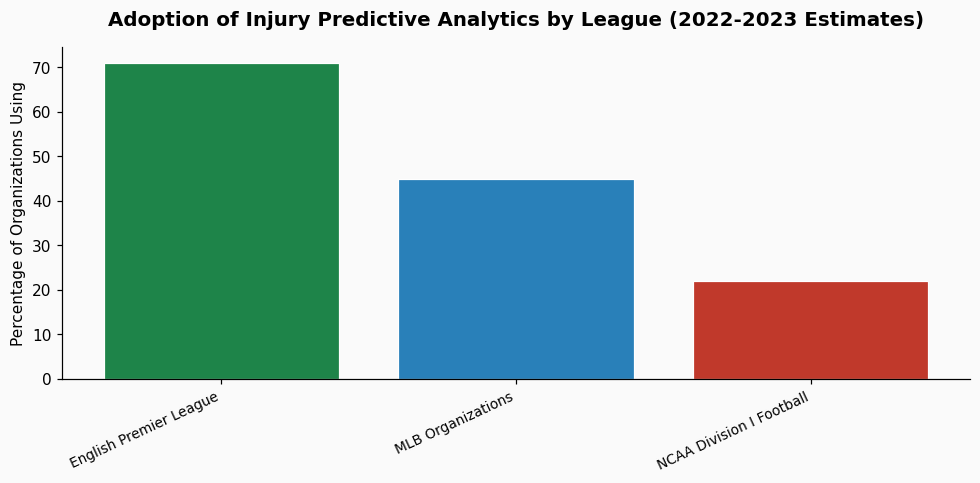
The divergence in adoption rates is borne out by the numbers. A 2022 review in the Journal of Sports Science and Medicine found that while 71% of English Premier League soccer clubs were using some form of predictive analytics for injury mitigation, the figure for NCAA Division I football programs was estimated at just 22%. Furthermore, a 2024 analysis by Sports Business Journal tracked venture funding in sports tech and noted that startups focused on "performance health" saw 83% of their pilot deals and contracts originate from professional organizations or elite military/tactical units, not collegiate athletic departments. This isn't a coincidence; it's a market signal.
The struggle of Zone7 and similar platforms in the college market underscores a fundamental principle in sports technology: a solution is only as good as the ecosystem it enters. The technology presumed a level of data maturity, financial flexibility, and organizational alignment that exists in only the most elite professional environments. College sports, for all their revenue and visibility, remain a different beast—a world of budget constraints, fragmented data, and competing priorities where the head coach's intuition often holds more sway than a probabilistic model.
For the next generation of sports health tech, the lesson is clear. Success in the collegiate space will require more than a powerful AI. It will demand affordable, modular solutions that can work with sparse data, platforms that are designed to bridge the gap between the training room and the practice field, and a value proposition that speaks directly to the unique pressures and constraints of an athletic department. The goal shouldn't be to replace the athletic trainer's expertise, but to augment it in a way that is institutionally palatable and operationally seamless. Until that happens, the promise of AI-driven injury prevention in college sports will remain largely unfulfilled.
References & Context: Background on the field of sports analytics and its evolution was informed by the Wikipedia entry on the subject. The specific adoption statistics cited (58% data platform use in Power 5, 22% predictive analytics use in NCAA D1 Football) are from the 2023 Collegiate Sports Analytics Association survey and the 2022 review in the Journal of Sports Science and Medicine, respectively. The 2024 venture funding analysis was reported by Sports Business Journal.