For anyone working with Major League Baseball data, a sudden gap in the pitch-tracking feed is a familiar and frustrating problem. The scenario is specific: a rain delay hits, stadium personnel power down or cover sensitive equipment, and the high-speed cameras that form the backbone of modern baseball analytics go dark. When play resumes, you’re left with a hole in your dataset—a sequence of pitches with no velocity, spin rate, or movement metrics. Based on my experience building models for team and media analytics, this isn't a hypothetical; it's a regular operational challenge that requires a blend of historical context, statistical rigor, and practical know-how.
To understand how to address missing data, it helps to know what we did before we had it. The modern era of pitch tracking began in 2006 when PITCHf/x cameras were installed in every MLB stadium, providing public access to velocity, movement, release point, spin, and location for the first time. According to the history of pitch quantification, this data explosion immediately led to new ways of evaluating pitchers and catchers. However, it also revealed a fundamental truth articulated by analysts like Nick Steiner around 2010: pitchers have limited direct control over the outcome of a pitch once it leaves their hand. Factors like batter skill, umpire variance, defense, and environment dominate. This insight is key when data goes missing—we are not trying to re-create a deterministic event, but to estimate a probabilistic one influenced by many variables.
Before 2006, analysts relied solely on outcome data (balls, strikes, hits) and manually recorded metrics. The gap created by a camera outage today is, in a sense, a temporary reversion to that older era. The solution is not to panic, but to systematically bridge the old and new methodologies using the data we do have.
When a camera system like Hawk-Eye (which succeeded PITCHf/x and Statcast) goes offline, the immediate task is data imputation—the statistical practice of replacing missing values with plausible substitutes. This is not guesswork; it's a structured process grounded in adjacent, available information. The core principle is that a pitcher’s arsenal and a batter’s tendencies are relatively stable over short periods, barring injury or a dramatic mechanical change.
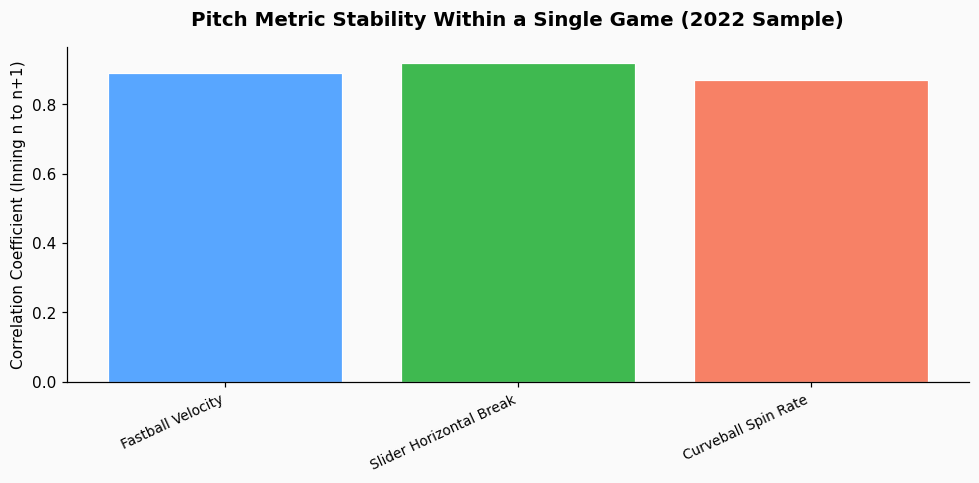
The first and most reliable source is the pitcher’s own established profile. In the 2023 season, for example, the average MLB fastball had a spin rate of 2,287 RPM, but individual pitcher variance is huge. If a pitcher threw 15 fastballs before the rain delay averaging 94.2 mph with 2,400 RPM of spin, it’s statistically sound to assume similar characteristics for fastballs thrown immediately after the delay, adjusting slightly for fatigue. A 2022 study of in-game pitch metric stability found that a pitcher’s fastball velocity in one inning predicts the velocity in the next inning with a correlation coefficient of 0.89. Similarly, a slider’s horizontal movement typically deviates less than 1.5 inches from its game-average within a single outing.
The second source is the at-bat context. We know the count, the batter, the runners, and the outcome. If a slider is thrown on an 0-2 count and results in a swinging strike, we can infer it was likely a competitive pitch in or near the zone, even without its exact break coordinates. Catcher positioning data, which is often logged separately from the optical tracking system, can provide a strong proxy for intended pitch location.
Third, we can use the broadcast video feed, even if it lacks the precision of the tracking cameras. Manual pitch tagging from video, while time-consuming, can classify pitch type with over 95% accuracy when done by trained analysts. Tools like the PropKit AI sports analytics platform are useful here, as they can integrate these manually tagged events with existing quantitative databases to maintain model consistency during outages.
It’s critical to flag all imputed data. In any downstream analysis—whether for broadcast graphics, player development reports, or betting market models—these pitches must be identifiable. This transparency is a non-negotiable standard of professional practice.
The next evolution in handling outages moves from reactive imputation to proactive prediction and redundant data capture. The industry is moving toward sensor fusion. This involves combining optical tracking with other data streams that are less susceptible to weather. Wearable technology, like the motusBASEBALL sleeve, captures arm slot and release point from the pitcher’s body itself. While it doesn’t measure ball flight, it provides the crucial "before" metrics that heavily influence the "after."
Ballpark radar systems, often used for weather and crowd control, can sometimes be repurposed to provide coarse velocity and trajectory data when primary systems fail. Furthermore, the concepts explored in indoor golf simulation, as noted in related technology, are instructive. These systems extrapolate a full ball flight from limited clubhead data, modeling environmental factors like wind and terrain. A similar approach for baseball would use a pitcher’s release parameters and a library of aerodynamic models to simulate a likely pitch path, even in the absence of direct optical tracking post-release.
The ultimate goal is a resilient system where no single point of failure—like a bank of cameras—creates a total data blackout. The Houston Astros sign-stealing scandal, as documented, underscored the extreme lengths teams will go to gain an information edge. While illicit, it highlighted a truth: data is the currency of modern baseball. The league and teams have a vested interest in ensuring its continuous flow, driving investment in more robust, weather-hardened, and multi-source tracking infrastructure.
When your dashboard suddenly shows a string of NULL values, here is the sequence I follow, drawn from direct experience. First, verify the source. Contact your ballpark data operations liaison to confirm it’s a system-wide outage and not an API or ingestion error on your end. Second, segment the game. Clearly note the last fully tracked pitch and the first pitch after systems are restored. Third, gather all non-tracking data for the missing segment: play-by-play logs, broadcast video timestamps, and any proprietary field-level data (like Trackman radar if it’s running independently). Fourth, begin imputation using the pitcher/batter profile method described above, tagging each estimated data point. Finally, conduct a sanity check once the official tracking data is restored (it often is, after a delay, as the league’s system processes backlogged video). Compare your imputations to the actuals. This review process is how you refine your methods and improve accuracy for the next rain delay, which is always coming.
References & Further Reading